Best Alternatives to Discourse for Community Platforms in 2026
Mar 16, 2026
Looking for a Discourse alternative that better fits your community goals? You're not alone. While Discourse has earned its reputation as a powerful open-source forum platform, its steep learning curve, resource-intensive hosting requirements, and pricing structure can make it challenging for many teams, especially SaaS companies looking for seamless integration, in-app embedding, and scalability.
I've spent countless hours comparing community platforms, and I know how overwhelming it can be to find the right fit. The good news? There are several excellent alternatives to Discourse forum software that offer modern interfaces, easier setup, and features tailored specifically for customer engagement and community building as a software/SaaS company.
In this guide, I'll walk you through the best discussion platform alternatives to Discourse, helping you find a solution that matches your budget, technical capabilities, and community vision.
Why Consider Alternatives to Discourse?
Before diving into specific platforms, let's talk about why teams search for Discourse alternatives in the first place.
Discourse is undeniably powerful. It's open-source, highly customizable, and offers robust moderation tools. But that power comes with trade-offs. The platform runs on Ruby and Docker, which requires technical expertise to self-host and maintain. Even managed hosting plans start at around $50-100 per month and can scale to $300+ for higher-traffic communities.
The interface, while modern, can feel overwhelming for new users. And if you're a SaaS company looking to embed your community directly into your product, Discourse's integration capabilities are limited compared to platforms built specifically for that purpose.
Many community managers tell me they love the idea of Discourse but need something more accessible, easier to integrate, or better aligned with their specific use case - whether that's customer support, product feedback, or customer success initiatives.
Top Discourse Alternatives Compared
Let's explore the leading alternatives to Discourse, broken down by what makes each one unique.
Turf – Best for SaaS Companies Seeking Deep Integration
If you're a SaaS or tech company and need a community platform that lives inside your product, Turf deserves serious consideration. Unlike Discourse, which requires users to visit a separate site, Turf offers embeddable forum software that integrates directly into your existing customer interface (on top of also providing a standalone separate site).
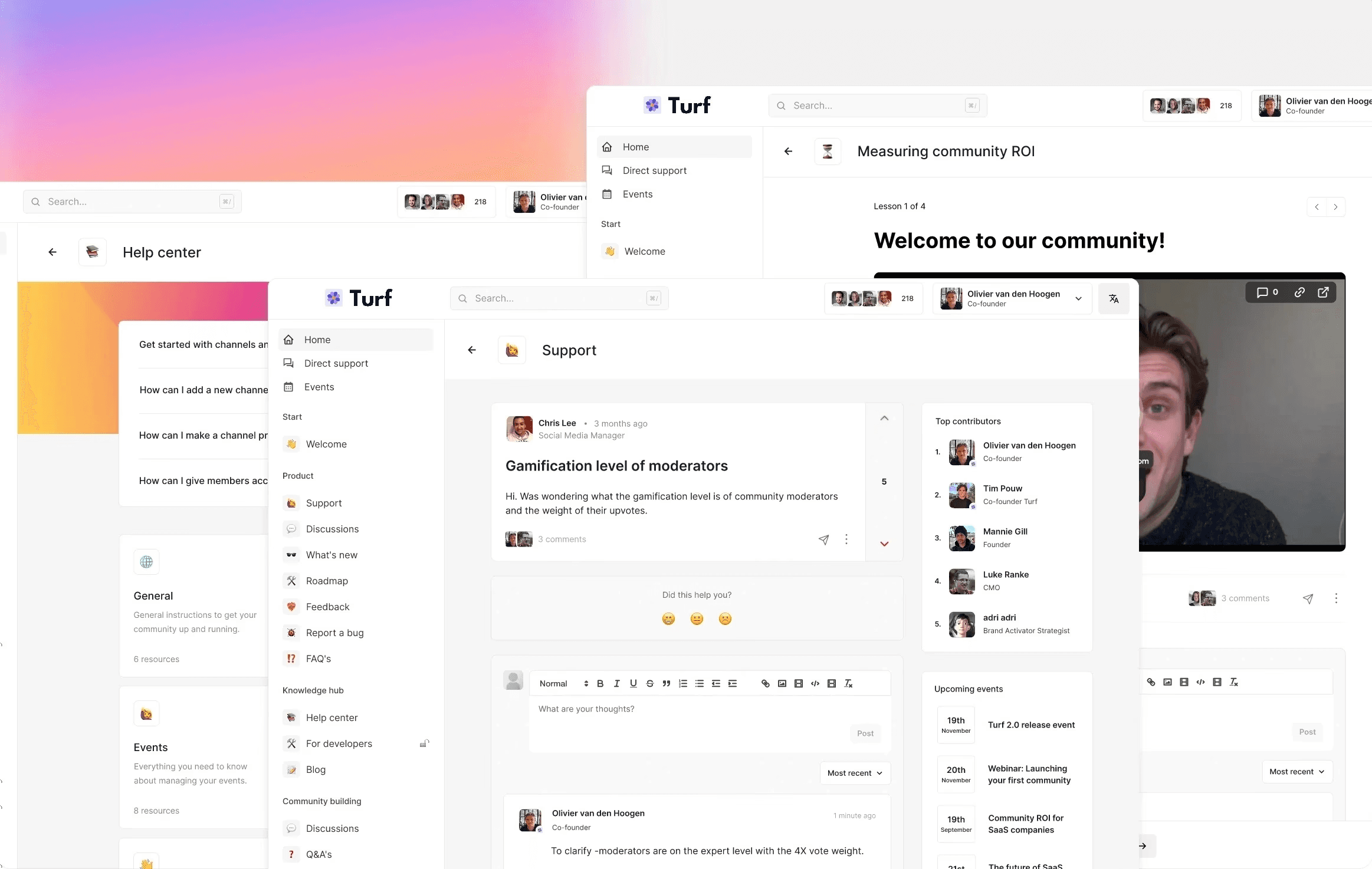
What makes Turf stand out is its all-in-one approach: you get customizable forums, customer feedback boards, a knowledge base for documentation, gamification features, and deep analytics, all designed to increase customer engagement and reduce churn. The platform integrates seamlessly with major CRMs like Salesforce, HubSpot, and Pipedrive, centralizing your customer data.
Turf's in-app widget is a game-changer. Your customers can access community discussions, submit ideas, browse help docs, and create support tickets without ever leaving your product. This drives adoption rates significantly higher than standalone community sites.
Best for: Mid-sized to large SaaS companies focused on customer retention, product-led growth, and reducing support costs.
Circle – Best for Creator-Focused Communities
Circle has rapidly become one of the most popular Discourse alternatives, especially among coaches, creators, and course builders. The platform combines the structure of traditional forums with the feel of modern social networks, creating an intuitive experience that members love.
What Circle does brilliantly is blend multiple content types: long-form discussions, live chat, events, courses, and member directories, into one cohesive space. The interface is clean and mobile-friendly, with a significantly lower learning curve than Discourse.
Pricing starts around $49/month for smaller communities, scaling up based on features and member counts. Circle doesn't offer native embedding within your own product, which may be a limitation if seamless integration is critical to your strategy.
Best for: Coaches, educators, and membership-based communities where courses and events are central to engagement.
Bettermode – Best for Customization and Branding
Bettermode (formerly Tribe) positions itself as a highly customizable community platform with ready-to-use templates and a powerful app ecosystem. If branding consistency is important to you, Bettermode offers extensive design control to match your company's look and feel.
The platform supports multiple community types: forums, Q&A boards, ideation hubs, and knowledge bases, all within one environment.
Pricing starts at around $399/month for self-service plans, positioning it at a higher price point than many alternatives. The trade-off is greater flexibility and enterprise-grade features.
Best for: Brands and organizations that need extensive customization and are willing to invest in a premium solution.
Mighty Networks – Best for Monetization and Courses
Mighty Networks targets creators and organizations looking to combine community with courses and memberships. The platform offers flexible pricing plans starting at $79/month, with features specifically designed to help you monetize your community.
One standout feature is "Spaces," which allows you to organize your community into topic-specific areas. Mighty Networks also includes AI-powered tools to suggest connections between members and surface relevant content.
While great for creators, Mighty Networks lacks some of the technical integration capabilities that SaaS companies need, particularly around CRM synchronization and in-app embedding.
Best for: Entrepreneurs and organizations building paid communities around educational content.
Flarum – Best Open-Source Alternative
If you loved Discourse's open-source nature but want something simpler and more lightweight, Flarum is worth exploring. Built on PHP instead of Ruby, Flarum runs efficiently on shared hosting environments, making it more accessible for smaller teams.
The interface is clean and modern, with a focus on simplicity and speed. Flarum's extension ecosystem allows you to add features as needed without overwhelming new users. The development community is active, though smaller than Discourse's.
As open-source software, Flarum is free, but you'll need to handle hosting and maintenance yourself. It's ideal for technically capable teams who want control without Discourse's resource requirements.
Best for: Small to mid-sized communities with technical resources who value simplicity and open-source flexibility.
How to Choose the Right Platform for Your Needs
With so many options, how do you pick the best alternative to Discourse for your specific situation? Here are the key factors I recommend evaluating:
Integration Requirements
If you're a SaaS company, integration capabilities should be at the top of your list. Can the platform embed directly into your product? Does it sync with your CRM? Can you pull analytics into your existing dashboards? Platforms like Turf are built specifically for this, while creator-focused platforms may fall short.
Technical Resources
Open-source solutions like Flarum and Discourse offer flexibility but require technical expertise to host, maintain, and customize. Managed platforms like Circle and Turf handle infrastructure for you, letting you focus on community building rather than server management.
Community Size and Scale
Some platforms excel with smaller, intimate communities while others are built to handle enterprise-level scale. Consider not just your current size but where you'll be in 12-24 months. Reducing customer churn through community often means significant growth.
Budget and Pricing Model
Pricing varies dramatically across platforms. Open-source options are free but come with hosting costs and technical overhead. Managed platforms range from $49/month to $400+/month depending on features and scale. Factor in not just the subscription cost but also implementation time and ongoing maintenance.
Primary Use Case
Are you building a customer support community, a product feedback hub, a learning environment, or a general discussion space? Different platforms optimize for different use cases. SaaS companies benefit most from platforms that integrate community forums with customer success tools that can embed inside their own product and application.
Key Features to Look For
Regardless of which platform you choose, make sure it includes these essential features:
In-app embed functionality: Make sure you can easily embed and integrate your community environment inside your own application or product.
Moderation Tools: Effective community management requires robust moderation capabilities, including spam filters, user management, and content reporting.
Search Functionality: Members should be able to find existing discussions and answers easily, reducing duplicate questions and support tickets.
Analytics and Insights: Understanding engagement patterns, active members, popular topics, and content performance is crucial for improving community adoption.
Customization Options: The ability to match your brand's look and feel creates a cohesive experience for your members.
Integrations: Whether it's SSO, CRM syncing, or webhook capabilities, integration flexibility determines how well your community fits into your broader tech stack.
Making the Switch: Migration Considerations
If you're already running a Discourse community and considering a switch, migration planning is essential. Most platforms offer import tools for content and user data, but the process varies in complexity.
Key migration considerations include:
Preserving SEO value from existing indexed content
Maintaining user accounts and login credentials
Transferring historical discussions and attachments
Setting up proper redirects from old URLs
Communicating changes clearly to your community members
Some platforms, including Turf, offer white-glove migration services to handle the technical details and ensure a smooth transition.
Final Thoughts
There's no single "best" Discourse alternative, the right choice depends on your specific needs, resources, and goals. Creator-focused communities might thrive on Circle or Mighty Networks. Open-source enthusiasts may prefer Flarum or NodeBB. And SaaS companies focused on customer engagement and retention often find that platforms like Turf, built specifically for their use case, deliver the best results.
The most important thing is to start with clarity about what you're trying to achieve. Are you looking to reduce support costs? Gather product feedback? Build customer loyalty? Lower churn rates? Your community strategy should drive your platform choice, not the other way around.
Take advantage of free demos to test platforms with real use cases before committing. The best community platform is one your team will actually use and your members will genuinely love.
FAQ's
What is the best alternative to Discourse for SaaS and tech companies?
Turf is the only Discourse alternative truly tailored to and build for SaaS and software companies. If you need the ability to embed and integrate your community environment inside your own application or product, need detailed business impact analytics, and want a highly customizable platform, Turf is your go to.
SaaS companies typically benefit most from platforms designed specifically for customer engagement and retention. Turf is built for this use case, offering embeddable forums, customer feedback boards, and deep integrations with CRM and marketing tools. The platform helps reduce support costs while increasing community adoption through seamless in-app integration.
Can I migrate my existing Discourse community to another platform?
Yes, migration is possible and most modern community platforms offer import tools or migration services. The process typically includes transferring user accounts, historical discussions, and attachments. Many platforms, including Turf, provide white-glove migration services to ensure your SEO value, user data, and content are preserved during the transition.
How much does it cost to run a community platform?
Costs vary widely depending on the platform and your needs. Open-source solutions like Flarum may be free to download but require hosting and maintenance costs. Hosted platforms typically charge monthly or yearly fees ranging from $39 to several thousand dollars based on member count and features. Consider both direct platform costs and indirect costs like development time and ongoing maintenance when budgeting.
What features should I prioritize when choosing a Discourse alternative?
Focus on features that align with your community goals. For customer engagement, prioritize easy integration, customization options, and analytics. For reducing support burden, look for knowledge base capabilities and feedback collection tools. For member retention, consider gamification, private messaging, and member segmentation features. The right mix depends on whether your primary goal is support, feedback, engagement, or retention.