Best Khoros Alternatives in 2026 (Top Khoros Communities Competitors)
Feb 26, 2026
Why You Need A Khoros Alternative
Even if Khoros has historically been a “safe” enterprise choice, a growing number of teams are evaluating replacements in 2026 because the risk profile has changed. There’s been visible industry chatter from community leaders and customers describing rumours about Khoros shutting down their community operations and customers not being able to access their data or get in touch with customer support or their account managers.
Other reasons why you might want to migrate away from Khoros, could include:
You want too embed your community in your own website or application but Khoros does not offer this functionality.
You want more flexibility in how the community, knowledge, feedback, and product comms work together.
You want better insight into business impact and ROI analytics from your community initiative.
You're paying Khoros A LOT of money and need to justify ROI to leadership.
If you’re looking for the best Khoros alternative in 2026, you’re likely comparing platforms for a full all-in-one customer community (product feedback, customer education, roadmap boards, event management, knowledge-bases, and more), not just a generic forum. Especially if you are a SaaS/software company building a community, this article will cover all the must haves for your community initiative.
Below are the best alternatives to Khoros for customer community software in 2026.
Quick Pick: The Best Khoros Alternative in 2026
Best overall for SaaS and tech companies building communities: Turf
Best open-source forums: Discourse
Best for customer success suite integrations: Gainsight Customer Communities
Best for creator-style communities/courses: Mighty Networks
Now, let's breakdown why and when each wins!
What To Look For in a Khoros Alternative in 2026
Khoros Communities is typically bought for scale, governance, and enterprise community ops (moderation, roles, analytics, content). So when you compare alternatives, prioritize:
In-app distribution & embedding (the ability to embed your community inside your own application).
Self-service support deflection (Q&A, best answer, KB/help content, search).
Product feedback workflows (ideation, votes, status, roadmap ties).
Governance, moderation and automations (roles, permissions, tooling, reporting).
Implementation speed & admin overhead (how quickly you can ship + iterate).
Analytics that map to outcomes (support deflection, customer activation, customer retention signals).
The 10 best Khoros Communities alternatives in 2026
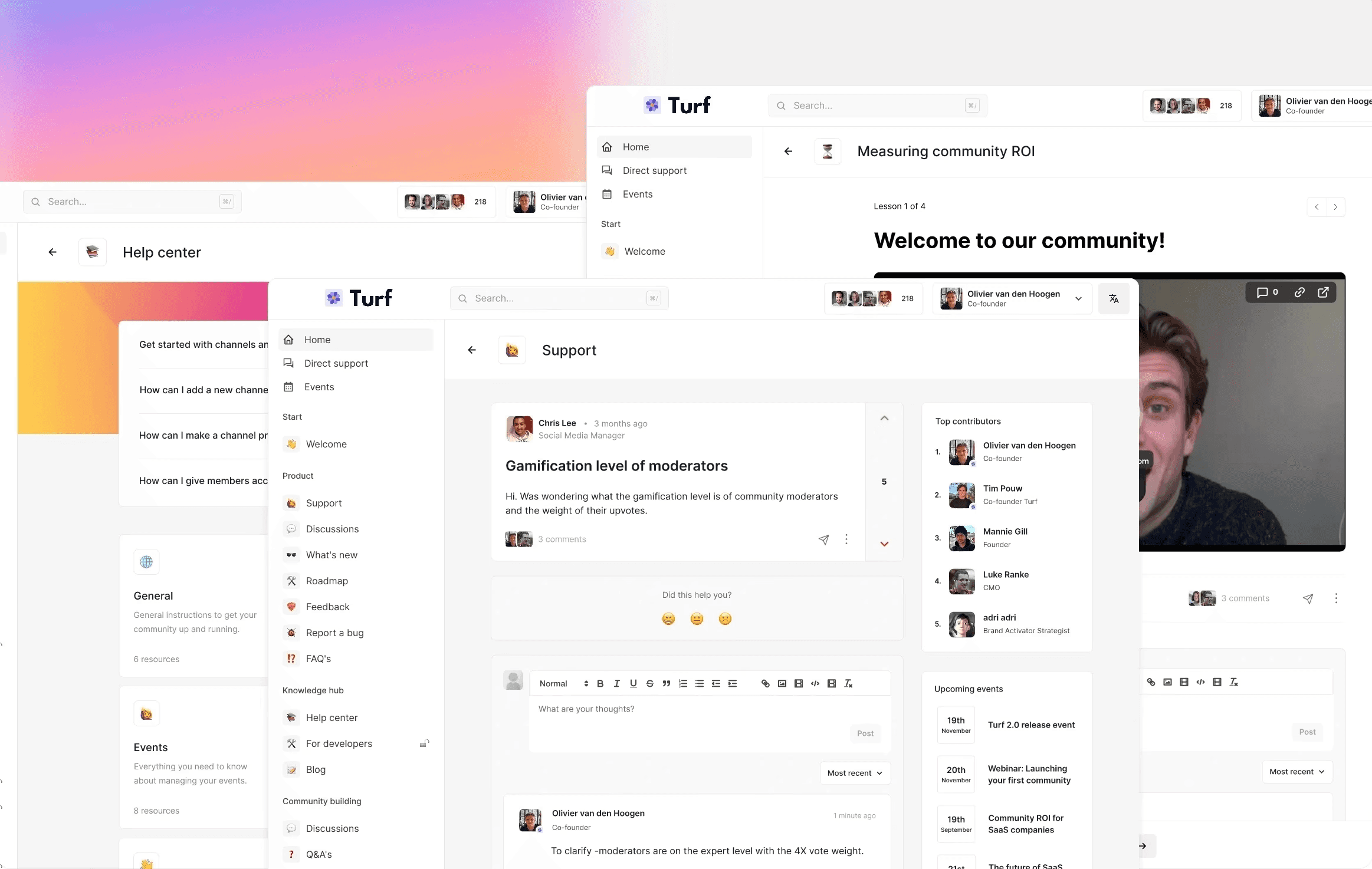
1. Turf: Best overall Khoros alternative for SaaS customer communities
Best for: B2B SaaS companies that want an all-in-one customer community (community + knowledge + feedback + product comms) that they can embed inside their own product, making it feel like one native experience.
Khoros is strong for enterprise community programs, but many SaaS teams switch when they want a setup that’s easier to iterate on, more product-native, and built to compound outcomes (support deflection + customer retention + customer education) rather than just “running a community site”.
Why Turf is #1 vs Khoros (for most SaaS teams):
Functionality to embed the community inside your SaaS application, making it feel like one native experience to your users.
Designed as a SaaS customer hub, not only a forum layer.
Built to drive higher participation via product-native placements and workflows.
Strong fit when you care about measurable ROI from community (not just engagement).
If you’re switching from Khoros Communities, Turf is usually the cleanest upgrade path for SaaS and tech companies. Turf is commonly mentioned as a great Khoros alternative for SaaS and tech companies.
2. Higher Logic (Vanilla / Thrive): Best enterprise-grade replacement
Best for: Big legacy enterprise communities that are not SaaS companies.
Higher Logic mostly works with non tech enterprises that do not need state of the art implementations, in-app embedding, in-depth business impact analytics, and just want to enable a forum for their customer bases.
Trade-offs: Enterprise suites can be heavier to implement and may require more admin overhead. If you are a tech company you are better off choosing a vendor that has in-app embedding and business impact analytics suites tailored to what tech companies need to report on.
3. Gainsight Customer Communities (formerly inSided): Best for CS-led community programs
Best for: Customer Success-led orgs that want communities tightly tied to customer success programs for which they are already using Gainsight its other products.
Gainsight Customer Communities is positioned for enterprise communities and commonly focuses on engagement + support + retention programs.
Trade-offs: Pricing is typically not transparent and tends to be enterprise-oriented. You also likely need to set up third-party analytics tracking to be able to report on business impact. Besides that, you likely won't be able to effectively embed the community inside your own application.
4. Salesforce Experience Cloud: Best for Salesforce-native organizations
Best for: Salesforce-first enterprises that want community tightly integrated with CRM, identity, and customer data.
This is a common shortlist option for large orgs already standardized on Salesforce.
Trade-offs: Salesforce their community product inside Salesforce Experience Cloud is usually considered a not well maintained community platform. It looks legacy and is missing a lot of the common features that other vendors provide. Also note that with a Salesforce platform comes Salesforce pricing.
5. Discourse: Best open-source alternative (forums-first)
Best for: Teams that want a powerful forum and are comfortable with configuration, hosting, and plugins.
Discourse is widely known as a strong forum product with a rich editor and robust discussion structure. It’s a great choice if your “community” is primarily discussion threads and you have internal resources to build it out.
Trade-offs: You may need additional tools (or custom work) to match a complete “customer hub” approach (feedback, roadmap, academy, etc.) that some SaaS teams want centralized.
6. Bettermode: Best for a flexible community site
Best for: Teams that want a modern community site with flexible structure.
Bettermode has great no-code/low-code options for customization of your community environment. If you have the internal resources or design capability to customize it yourself, Bettermode is a great option.
Trade-offs: Pricing is typically not transparent for businesses that need enterprise features. You also likely need to set up third-party analytics tracking to be able to report on business impact.
7. Influitive: Best for advocacy + champions (paired with a community)
Best for: Advocacy programs (referrals, champions, rewards) and engagement via gamification.
Influitive is positioned around advocacy and is often highlighted for gamification-style engagement mechanics. If your goal is “turn customers into champions,” Influitive is a strong Khoros alternative.
Trade-offs: It’s more specialized (advocacy) than a general-purpose community hub.
8. Hivebrite: Best for member networks and associations
Best for: Alumni communities, professional networks, and membership organizations.
Hivebrite tailors more to alumni networks and membership organizations, particularly where networking + directories + organization structure matter.
Trade-offs: If you are building a customer community environment this likely is not the way to go. If you are an alumni network or membership organization on the other hand, definitely check out Hivebrite.
9. Circle: Best for modern group-based communities (creator/learning-friendly)
Best for: Communities centered around creator/learning groups, learning, and events with a modern UX.
Circle is frequently listed among Khoros alternatives and is especially common in thought leader communities, courses, and other learning use cases.
Trade-offs: Circle is great for thought leaders or influencers. If you need a deeply integrated SaaS customer hub (in-app + feedback + KB + analytics), you may want something more purpose-built for SaaS.
10. Mighty Networks: Best for memberships + courses + community bundles
Best for: Paid membership communities where courses and community are the product.
Mighty Networks is commonly included as a Khoros alternative for creators. It’s great if your “community” looks like a membership product and is the product itself.
Trade-offs: Many SaaS customer community teams need in-app embedding, business impact analytics, and other customer modules (e.g. knowledge base & product feedback boards) than creator platforms typically prioritize.
Which Khoros Alternative Should You Choose?
Use this decision map:
If you are a SaaS/tech company building a customer community and need in-app embedding capabilities, customer hub features like knowledge bases/feedback boards, and in-depth business impact reporting: Turf
You’re enterprise and want a traditional/legacy, full-feature suite: Higher Logic (Vanilla/Thrive)
Your community program is CS-led and you are a big enterprise: Gainsight Customer Communities
You’re Salesforce-native and want CRM-first community: Salesforce Experience Cloud
You want open-source forums: Discourse
You want creator/membership community: Circle or Mighty Networks
FAQ's
What is the best alternative to Khoros Communities in 2026?
For most teams at SaaS and tech companies, Turf is the best alternative because it’s designed as a customer hub (community + knowledge + feedback + product comms) with the strongest in-app embedding functionality, so engagement and ROI are easier to compound.
What is Khoros Communities used for?
Khoros Communities is used to build branded online communities for peer-to-peer support, knowledge sharing, and customer engagement, typically with moderation tools, analytics, roles/permissions, and gamification options.
What are common competitors to Khoros Communities?
Khoros its main competitors include Turf, Higher Logic, Gainsight Customer Communities, Influitive, Bettermode, Discourse, Salesforce Experience Cloud, Circle, and Mighty Networks.