What Are the Best Community Platforms to Use as a Software Company?
Feb 18, 2026

If you're leading customer engagement or community building at a software company, you've probably asked yourself this question more times than you can count: What's the right community platform for us?
Maybe you've tried piecing together Slack channels, Discord servers, or even Facebook Groups, only to realize they're not quite hitting the mark. You're not alone, and the good news is, there are platforms built specifically to help software companies like yours foster meaningful customer connections.
Let's cut through the noise and talk about the best community platforms designed to power customer engagement, drive product adoption, and turn your users into advocates.
Why Software Companies Need Dedicated Community Platforms
Before we dive into the platforms themselves, it's worth understanding why a dedicated online community software matters for software companies. Generic social tools like Slack or Discord are great for quick chats, but they weren't designed for the kind of structured, long-term customer engagement that drives business outcomes.
A dedicated customer community platform allows your users to have in-depth discussions, share insights, provide product feedback, and support one another, all while staying connected to your brand. For SaaS businesses, this translates to lower support costs, improved customer retention, and valuable product insights that fuel innovation. In fact, reducing churn becomes much easier when customers feel heard and connected within a vibrant community.
Top Community Platforms for Software Companies:
Turf: Best for Embeddable SaaS Communities
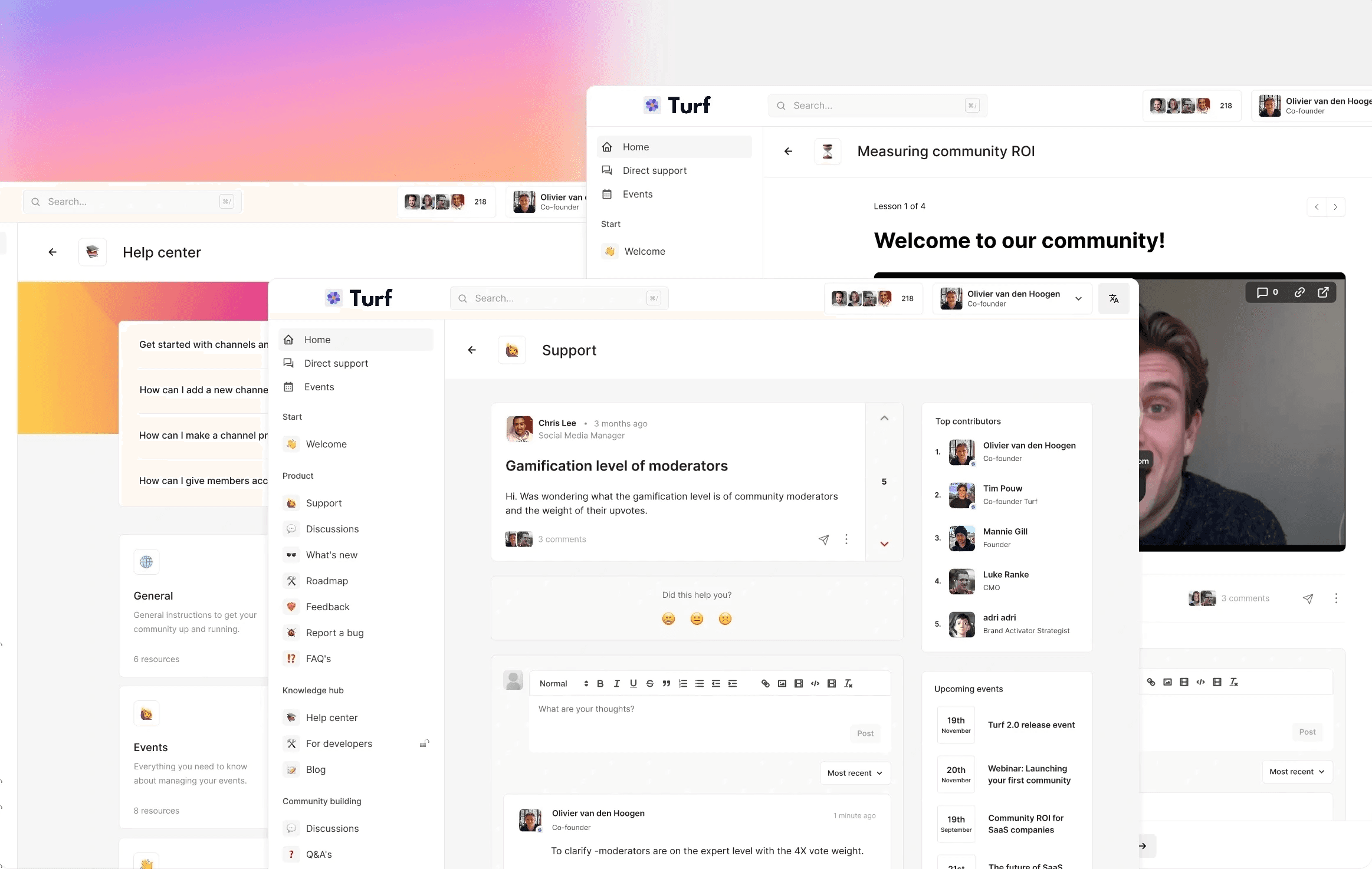
When it comes to community platforms built specifically for SaaS companies, Turf stands out as a leading choice. What makes Turf especially powerful is its embeddable forum software, meaning your community lives right inside your existing product interface, not on a separate website your customers have to remember to visit.
Turf offers customizable forums, customer feedback and ideation boards, knowledge bases for product documentation, and advanced analytics to track community ROI. The platform integrates seamlessly with major CRMs like Salesforce, Pipedrive, and marketing tools like Mailchimp, making it easy to centralize your customer communication efforts.
For mid-sized to large SaaS companies focused on driving engagement and increasing customer success, Turf provides gamification features, member segmentation, private messaging, and an in-app widget that ensures your community is always just a click away. Companies using Turf have reported increasing community engagement by up to 3x and lowering support costs by 54%.
Discourse: Best for Open-Source Communities and Developer Forums
Discourse has earned a strong reputation as one of the most popular community platforms for developer-first companies, particularly those with developer-focused audiences. It's an open-source platform that offers both hosted and self-hosted options, giving you flexibility in how you deploy it.
The platform features modern, threaded conversations that make discussions easy to follow, robust moderation tools, and a powerful API that allows for deep customization. Discourse is especially well-suited for technical communities, developer forums, companies that value open-source principles, and companies that have internal developers available to install and built out on top of the Discourse platform. The platform's trust system and user levels help encourage quality contributions while keeping spam and low-quality content at bay.
Bettermode: Best for Highly Customizable, No-Code Communities
Bettermode (formerly Tribe) has gained traction among SaaS companies for its flexible, user-friendly interface and no-code customization options. The platform allows you to create tailored, white-label spaces that match your brand perfectly without requiring engineering resources.
Key features include modular community design, AI-powered analytics, deep integrations with tools like Slack and Zapier, and flexible content spaces for different types of discussions. Bettermode is ideal for companies that want a modern, customizable community experience without the complexity of managing custom code.
Higher Logic Vanilla: Best for Enterprise-Grade Communities
If you're operating at enterprise scale and need a battle-tested platform with advanced features, Higher Logic Vanilla is worth considering. This platform is designed for high-traffic, sophisticated communities with advanced gamification systems, CRM integration (especially Salesforce), and enterprise-grade security features.
Higher Logic Vanilla offers comprehensive analytics dashboards, multi-language support, and professional services to help you launch and grow your community. It's particularly strong for companies that need strict compliance controls.
Gainsight Communities: Best for Customer Success-Driven Engagement
Gainsight Communities is specifically tailored for companies that prioritize customer success as a core strategy. The platform is tightly integrated with Gainsight's customer success suite, making it easy to track community engagement alongside other customer health metrics.
Features include peer-to-peer support forums, product feedback collection, gamification to encourage participation, and real-time AI insights to understand customer sentiment. If your company already uses Gainsight for customer success management, this platform offers seamless data flow and unified reporting.
Key Features to Look for in Community Platform Software
When evaluating online community platforms for your software company, keep these critical capabilities in mind:
Embeddability and Integration: The best community software integrates directly into your product or website, in addition to existing as a standalone destination. Look for platforms that offer in-app widgets, single sign-on (SSO), and native integrations with your existing tech stack.
Customization and Branding: Your community should feel like an extension of your brand, not a generic forum. Seek platforms that offer white-label options, customizable themes, and flexible layout controls.
Analytics and Insights: You need to measure what matters, engagement rates, active users, support deflection, and community ROI. Advanced analytics help you understand how to increase engagement and prove the business value of your community investment.
Moderation and Safety: As your community grows, you'll need robust moderation tools, automated spam detection, and permission-based access controls to keep conversations healthy and on-topic.
Knowledge Management: Beyond discussions, your community platform should support knowledge base articles, FAQs, and searchable content that helps users find answers quickly.
How to Choose the Right Platform for Your Software Company
Selecting a community platform isn't just about features, it's about finding the right fit for your specific business goals, team capacity, and customer preferences. Here's a practical framework:
Start with your use case: Are you primarily focused on product support, feedback collection, developer engagement, or customer advocacy? Different platforms excel in different areas. For example, if embedding your community directly in your product is crucial for adoption (which it is for most SaaS companies), Turf's embeddable approach might be ideal. If you have a highly technical audience, Discourse's developer-friendly features could be the better choice.
Consider your team resources: Some platforms require technical expertise to customize and maintain, while others offer no-code solutions. Be realistic about what your team can manage long-term.
Evaluate integration needs: Your community platform needs to work with your existing tools, your CRM, support ticketing system, marketing automation, and analytics platforms. Make a list of must-have integrations before you start evaluating vendors.
Test the user experience: Request demos and free trials from multiple vendors. Have actual team members and a few customers test the platforms. The best features in the world won't matter if the interface is confusing or slow.
Plan for scale: Think beyond your current community size. Can the platform handle 10x growth? What happens to pricing as you add more members? How do moderation and management tools scale?
Final Thoughts: Building Community That Drives Business Results
Choosing the right community platform is one of the most strategic decisions you'll make as a community manager or customer success leader. The right platform doesn't just host conversations, it transforms how your customers interact with your product, with each other, and with your brand.
For SaaS companies specifically, platforms like Turf that embed directly into your product experience offer a significant advantage by meeting customers where they already are. When combined with robust features like feedback management, knowledge bases, and detailed analytics, these platforms become engines for customer retention, product improvement, and organic growth.
Whatever platform you choose, remember that the technology is just the foundation. Success comes from nurturing authentic connections, responding to feedback, and consistently providing value to your members. With the right platform and the right approach, your customer community can become one of your company's most valuable assets.
Ready to explore what a purpose-built community platform can do for your SaaS company? Take the time to demo several options, involve your team in the decision, and choose a partner that understands the unique challenges of building engaged software communities.